News
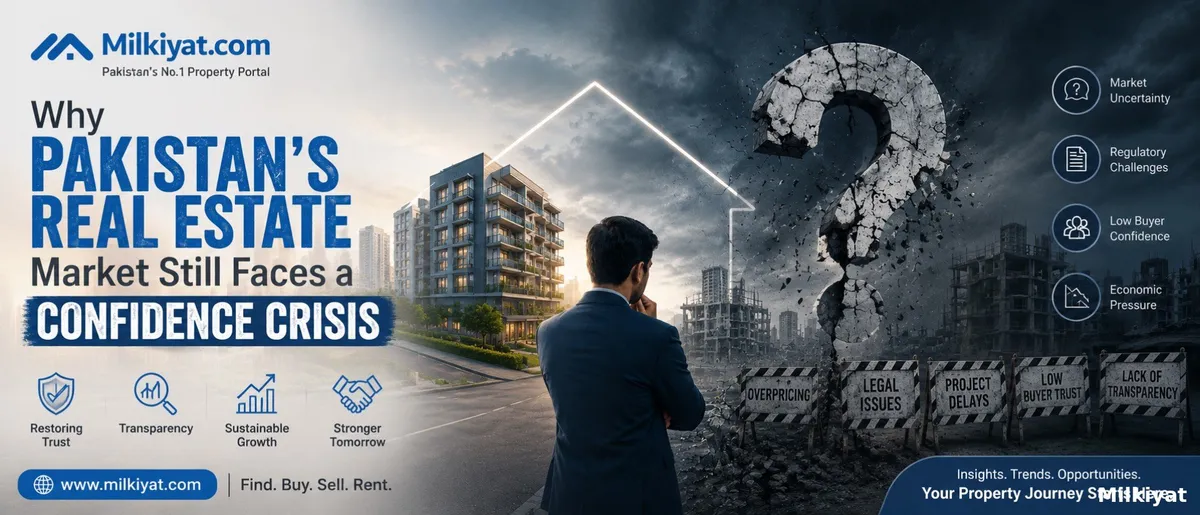
Why Pakistan’s Real Estate Market Still Faces a Confidence Crisis

Real Estate Analyst
Milkiyat.com is operated by MILKIYAT.COM ONLINE PORTAL (PRIVATE) LIMITED.
Corporate Unique Identification No. (CUI): 0337118
Incorporated under the Companies Act, 2017, Pakistan.
News
Real Estate Analyst
News
Real Estate Analyst
Pakistan’s real estate sector represents one of the largest stores of private wealth in the country. With a rapidly urbanizing population, a massive housing deficit estimated at over 10 million units, and billions of dollars in remittances flowing from overseas Pakistanis annually, the property market should be flourishing.
And yet, in 2026, it remains trapped in a confidence crisis.
While there are early signs of transaction recovery particularly in end-user-driven residential segments the fundamental issues that have eroded trust over the past decade have not been resolved. Buyers remain cautious. Investors are taking a “wait-and-see” approach. And first-time property purchasers are increasingly afraid of losing their life savings to fraudulent schemes.
Understanding why this confidence crisis persists is not just academically interesting — it is essential knowledge for anyone considering a property investment in Pakistan today. At Milkiyat, we believe that transparent, informed decisions are the foundation of a healthier property market. This blog breaks down the root causes of Pakistan’s real estate confidence problem in 2026 — and what it will take to fix it.
Perhaps nothing has done more damage to Pakistan’s real estate reputation than the staggering scale of illegal and unapproved housing societies operating across the country.
The numbers are alarming:
These are not fringe operations. Many of these societies run sophisticated marketing campaigns, build show offices, and engage real estate agents to attract buyers. They often collect billions of rupees in booking fees before development either stalls completely or turns out to be built on land the developers never legally owned.
Pakistan’s real estate sector represents one of the largest stores of private wealth in the country. With a rapidly urbanizing population, a massive housing deficit estimated at over 10 million units, and billions of dollars in remittances flowing from overseas Pakistanis annually, the property market should be flourishing.
And yet, in 2026, it remains trapped in a confidence crisis.
While there are early signs of transaction recovery particularly in end-user-driven residential segments the fundamental issues that have eroded trust over the past decade have not been resolved. Buyers remain cautious. Investors are taking a “wait-and-see” approach. And first-time property purchasers are increasingly afraid of losing their life savings to fraudulent schemes.
Understanding why this confidence crisis persists is not just academically interesting — it is essential knowledge for anyone considering a property investment in Pakistan today. At Milkiyat, we believe that transparent, informed decisions are the foundation of a healthier property market. This blog breaks down the root causes of Pakistan’s real estate confidence problem in 2026 — and what it will take to fix it.
Perhaps nothing has done more damage to Pakistan’s real estate reputation than the staggering scale of illegal and unapproved housing societies operating across the country.
The numbers are alarming:
These are not fringe operations. Many of these societies run sophisticated marketing campaigns, build show offices, and engage real estate agents to attract buyers. They often collect billions of rupees in booking fees before development either stalls completely or turns out to be built on land the developers never legally owned.
The pattern is well-established: a housing scheme is launched with attractive branding and promised amenities. Plots are sold often many more than the land area can accommodate. Then comes the inevitable: construction delays, disputed ownership, or outright abandonment.
Want to verify whether a housing society is legally approved before investing? Milkiyat’s Property Verification Guide outlines exactly how to check NOC status and developer credentials across Pakistan’s major cities.
Beyond outright illegal societies, Pakistan’s property market is riddled with fraudulent practices at every level from double-selling of plots to the notorious “file trading” culture that has devastated thousands of investors.
A recent case that shocked the industry involved a housing society in the Islamabad region where 42,000 files were issued for only 6,000 actual approved plots. Investors who purchased these files had no idea they were competing with six other buyers for the same physical plot. When development stalled and possession became impossible, many discovered the truth only years after parting with their savings.
This kind of scheme is not isolated. Common fraud types in Pakistan’s property market include:
The speculative file-trading culture deserves special attention. For years, property “files” — essentially booking documents for yet-to-be-developed plots — were traded like stocks, with investors flipping them for quick profits. This disconnected property prices from actual land value and development reality, creating artificial bubbles that eventually collapsed, leaving end buyers holding worthless paper.
For a deeper look at how to identify red flags before signing any agreement, read Milkiyat’s Complete Guide to Avoiding Property Fraud in Pakistan.
A housing society being declared illegal does not mean it stops operating. This is perhaps the most damaging reality for buyer confidence: enforcement is weak, and consequences for fraudulent developers are rare.
Development authorities cancel NOCs, courts impose fines, and the National Accountability Bureau (NAB) and other accountability agencies open criminal investigations. But these actions have not stopped developers from continuing their operations. Illegal societies remain profitable because:
The regulatory landscape in Pakistan is fractured across multiple agencies the CDA in Islamabad, the LDA in Lahore, the SBCA in Karachi, various DHAs, and provincial governments each with different standards, databases, and enforcement capacities. This fragmentation means that a developer blacklisted in one city can simply operate in another.
Experts have long called for a centralized national digital land registry a single source of truth where buyers can verify ownership, NOC status, and approved layouts before committing any funds. In 2026, this remains a work in progress rather than a reality.
Pakistan’s real estate market does not operate in a vacuum. The broader economic environment of the past few years has compounded structural problems with serious financial pressure.
Inflation: Pakistan’s Consumer Price Index (CPI) averaged above 20% in recent years a level that eroded purchasing power, made mortgages unaffordable, and forced many middle-income families out of the property market entirely.
High Interest Rates: The State Bank of Pakistan maintained elevated policy rates to combat inflation, which dramatically increased the cost of borrowing. While rates have begun to ease in 2025-26, the damage to housing finance demand was already done.
Currency Depreciation: The Pakistani rupee’s dramatic devaluation against the US dollar made imported construction materials significantly more expensive and introduced severe uncertainty for overseas Pakistani investors calculating returns in foreign currency.
Construction Cost Inflation: Global energy price volatility and supply chain pressures have caused the cost of key construction materials cement, steel, and labor to surge sharply compared to three years ago. This has slowed new project launches and put financial pressure on developers already struggling with pre-sales.
These macroeconomic headwinds hit the middle-income segment hardest. Properties priced within reach of salaried buyers became unaffordable, while developers pulled back from affordable housing projects in favor of luxury segments that could better absorb cost increases. The result: a widening gap between housing supply and genuine demand.
Explore Milkiyat’s Pakistan Real Estate Market Analysis 2026 for detailed price trend data across Karachi, Lahore, and Islamabad.
Overseas Pakistanis particularly those based in the Gulf, the UK, and North America have historically been the backbone of Pakistan’s high-end real estate market. Remittances fund a significant portion of property purchases, and overseas buyers tend to invest in larger plots and premium developments.
But this segment is uniquely vulnerable to fraud, and in 2026, that vulnerability continues to suppress confidence and investment flows.
The reasons are straightforward: overseas buyers cannot frequently visit to verify developments in person. They rely on agents, family members, and marketing materials all of which can be manipulated. Common traps that overseas investors fall into include:
Gulf region geopolitical tensions in early 2026 added another layer of complexity. With uncertainty affecting Pakistani workers in the Middle East who account for roughly 54% of Pakistan’s total remittances — new investment inflows slowed even further. When the primary source of real estate liquidity becomes uncertain, market confidence suffers at every level.
The emotional dimension of overseas Pakistani investment also makes fraud especially devastating. For many expats, buying property in Pakistan is not purely financial it is tied to identity, family, and the dream of returning home. Losing those savings to fraud carries a psychological weight that goes beyond monetary loss.
Read more on protecting overseas investments at Milkiyat’s Guide for Non-Resident Pakistanis Investing in Property.
Investor confidence is impossible to build in a politically unstable environment — and Pakistan’s political landscape over the past several years has provided anything but stability.
Frequent changes in government, economic mini-crises, IMF bailout negotiations, and abrupt policy reversals have created an environment where long-term investment planning feels risky. Real estate projects typically take three to seven years from launch to delivery. Investors need confidence that the rules — tax rates, capital gains structures, foreign currency regulations will remain broadly stable over that period.
They have not been getting that confidence.
Key policy pain points that have shaken the market include:
There is a silver lining: the 2025-26 Federal Budget did include some property-friendly measures, including reductions in withholding tax and the elimination of Federal Excise Duty on commercial plots. But until these signals translate into consistently enforced, long-term policy stability, cautious investors will continue to sit on the sidelines.
Even from buyers who willingly commit to a legitimate, approved housing project, the confidence crisis has a third dimension: will the project actually be delivered on time?
The answer, in Pakistan’s real estate market, is often: probably not.
Delayed delivery is one of the most common complaints among property investors. Developers may face funding issues, regulatory hurdles, construction challenges, or simply poor project management. What was promised as a 2-year development stretches to 5, then 7, then indefinitely.
Skyrocketing construction costs have made this problem worse in 2025-26. As cement, steel, and labor costs rose sharply, some developers found that the revenue from pre-sold plots at original prices was insufficient to complete development at current costs. The result: construction slows, buyers wait, trust erodes.
This problem is particularly acute for buyers who have taken out loans or redirected personal savings into a development expecting timely possession. When possession is delayed by years, the financial and personal cost can be severe.
Some warning signs of a project at risk of delivery delays include:
Milkiyat’s Developer Due Diligence Checklist can help buyers assess a project’s likelihood of on-time delivery before committing.
One of the most under appreciated factors fueling Pakistan’s real estate confidence crisis is the deep entanglement between the country’s media landscape and its property developers a relationship that systematically distorts public information about the sector. Research has documented a striking pattern: six of Pakistan’s most prominent real estate developers each own a television news channel. Of Pakistan’s 31 licensed news channels, these six developers control five — representing 16% of the media market. The channels involved include major names in Pakistani news broadcasting.
The implications for real estate reporting are serious. Media outlets owned by developers have an inherent conflict of interest when reporting on:
When the gatekeepers of public information about real estate are simultaneously some of the largest real estate sellers in the country, objective reporting becomes structurally difficult. Buyers relying on media coverage to make informed investment decisions cannot assume the information they receive is independent.
This media-developer nexus also extends to social media. Influencer marketing has become a significant driver of real estate sales in Pakistan, with celebrities and online personalities promoting housing schemes sometimes illegal ones to their followers. Regulatory oversight of this advertising is minimal.
For unbiased property news and market analysis, bookmark Milkiyat’s Real Estate News Pakistan — a platform committed to editorial independence from developer interests.
To be fair, 2025-26 has seen a genuine uptick in reform efforts aimed at addressing the confidence crisis. The question is whether these efforts are sufficient, sustained, and structurally meaningful.
NAB’s Online Property Information System: The National Accountability Bureau has launched an online portal linking standard operating procedures, layout plans, and approval details of private housing societies. The system aims to allow buyers, overseas Pakistanis, and investors to verify a project’s legal status before making any payment. Development authorities from all districts are expected to provide verified layout plans to NAB for inclusion in the centralized database.
CDA Enforcement Actions: The Capital Development Authority has taken a multi-pronged approach in Islamabad publishing lists of unapproved projects, issuing show-cause notices, sealing offices of illegal developers, and filing criminal cases against repeat offenders. The 2026 list of 98 unapproved projects in Islamabad’s Zones 3 and 4 represents a meaningful transparency effort.
NAB Chairman Reforms Announcement: The NAB Chairman outlined measures requiring future housing projects to regulate plot transfers through proper authorities, discourage cash transactions in favor of banking channels, and ensure that housing schemes do not sell more plots than the land available a direct response to the file-overselling scandal.
Budget Measures: Reductions in withholding tax and elimination of Federal Excise Duty on commercial plots aim to reduce the transaction cost burden and stimulate legitimate market activity.
These are meaningful steps. But experts argue they fall short of what is needed:
While systemic reforms take time, buyers can take concrete steps to protect themselves in Pakistan’s current property market. Due diligence is no longer optional — it is essential.
Before signing anything:
Pakistan’s real estate market is showing green shoots of recovery in 2026. Transaction volumes are slowly improving. Interest rates are easing. Some government reforms are taking hold. And genuine demand from a young, urbanizing population and a significant overseas diaspora has not gone away.
But recovery is not the same as confidence. Prices stabilizing and transactions ticking up does not mean that the structural problems rampant fraud, weak enforcement, media conflicts of interest, fragmented land records, and policy instability have been resolved. They have not.
True confidence in Pakistan’s property market will require:
Until these foundations are in place, buyers will remain cautious and rightly so. The best investment strategy in Pakistan’s real estate market in 2026 is one built on thorough research, independent verification, and a clear-eyed assessment of risk.
At Milkiyat, our mission is to bring transparency and verified information to every step of Pakistan’s property journey from your first search to the moment you receive possession. Because in a market where confidence is still fragile, knowledge is the most valuable asset you can have.
© 2026 Milkiyat. All rights reserved. This article is for informational purposes only and does not constitute legal or financial advice. Always consult qualified legal and financial professionals before making property investment decisions.
RDA inflows reached $14.906 billion in August, reflecting stronger overseas investment and growing confidence in Pakistan’s real estate and development sector.
Up to 50mm of rain hit Islamabad as CDA teams carried out dewatering and drainage operations at waterlogging points, highlighting the capital’s recurring monsoon drainage problems.
Pakistan’s LNG supply shock is increasing pressure on gas, electricity and construction costs, adding another major risk for developers, businesses and property owners.
Pakistan’s FX reserves have climbed to a record $21.4 billion after the $3 billion Eurobond inflow, strengthening the outlook for currency and import-cost stability.
The pattern is well-established: a housing scheme is launched with attractive branding and promised amenities. Plots are sold often many more than the land area can accommodate. Then comes the inevitable: construction delays, disputed ownership, or outright abandonment.
Want to verify whether a housing society is legally approved before investing? Milkiyat’s Property Verification Guide outlines exactly how to check NOC status and developer credentials across Pakistan’s major cities.
Beyond outright illegal societies, Pakistan’s property market is riddled with fraudulent practices at every level from double-selling of plots to the notorious “file trading” culture that has devastated thousands of investors.
A recent case that shocked the industry involved a housing society in the Islamabad region where 42,000 files were issued for only 6,000 actual approved plots. Investors who purchased these files had no idea they were competing with six other buyers for the same physical plot. When development stalled and possession became impossible, many discovered the truth only years after parting with their savings.
This kind of scheme is not isolated. Common fraud types in Pakistan’s property market include:
The speculative file-trading culture deserves special attention. For years, property “files” — essentially booking documents for yet-to-be-developed plots — were traded like stocks, with investors flipping them for quick profits. This disconnected property prices from actual land value and development reality, creating artificial bubbles that eventually collapsed, leaving end buyers holding worthless paper.
For a deeper look at how to identify red flags before signing any agreement, read Milkiyat’s Complete Guide to Avoiding Property Fraud in Pakistan.
A housing society being declared illegal does not mean it stops operating. This is perhaps the most damaging reality for buyer confidence: enforcement is weak, and consequences for fraudulent developers are rare.
Development authorities cancel NOCs, courts impose fines, and the National Accountability Bureau (NAB) and other accountability agencies open criminal investigations. But these actions have not stopped developers from continuing their operations. Illegal societies remain profitable because:
The regulatory landscape in Pakistan is fractured across multiple agencies the CDA in Islamabad, the LDA in Lahore, the SBCA in Karachi, various DHAs, and provincial governments each with different standards, databases, and enforcement capacities. This fragmentation means that a developer blacklisted in one city can simply operate in another.
Experts have long called for a centralized national digital land registry a single source of truth where buyers can verify ownership, NOC status, and approved layouts before committing any funds. In 2026, this remains a work in progress rather than a reality.
Pakistan’s real estate market does not operate in a vacuum. The broader economic environment of the past few years has compounded structural problems with serious financial pressure.
Inflation: Pakistan’s Consumer Price Index (CPI) averaged above 20% in recent years a level that eroded purchasing power, made mortgages unaffordable, and forced many middle-income families out of the property market entirely.
High Interest Rates: The State Bank of Pakistan maintained elevated policy rates to combat inflation, which dramatically increased the cost of borrowing. While rates have begun to ease in 2025-26, the damage to housing finance demand was already done.
Currency Depreciation: The Pakistani rupee’s dramatic devaluation against the US dollar made imported construction materials significantly more expensive and introduced severe uncertainty for overseas Pakistani investors calculating returns in foreign currency.
Construction Cost Inflation: Global energy price volatility and supply chain pressures have caused the cost of key construction materials cement, steel, and labor to surge sharply compared to three years ago. This has slowed new project launches and put financial pressure on developers already struggling with pre-sales.
These macroeconomic headwinds hit the middle-income segment hardest. Properties priced within reach of salaried buyers became unaffordable, while developers pulled back from affordable housing projects in favor of luxury segments that could better absorb cost increases. The result: a widening gap between housing supply and genuine demand.
Explore Milkiyat’s Pakistan Real Estate Market Analysis 2026 for detailed price trend data across Karachi, Lahore, and Islamabad.
Overseas Pakistanis particularly those based in the Gulf, the UK, and North America have historically been the backbone of Pakistan’s high-end real estate market. Remittances fund a significant portion of property purchases, and overseas buyers tend to invest in larger plots and premium developments.
But this segment is uniquely vulnerable to fraud, and in 2026, that vulnerability continues to suppress confidence and investment flows.
The reasons are straightforward: overseas buyers cannot frequently visit to verify developments in person. They rely on agents, family members, and marketing materials all of which can be manipulated. Common traps that overseas investors fall into include:
Gulf region geopolitical tensions in early 2026 added another layer of complexity. With uncertainty affecting Pakistani workers in the Middle East who account for roughly 54% of Pakistan’s total remittances — new investment inflows slowed even further. When the primary source of real estate liquidity becomes uncertain, market confidence suffers at every level.
The emotional dimension of overseas Pakistani investment also makes fraud especially devastating. For many expats, buying property in Pakistan is not purely financial it is tied to identity, family, and the dream of returning home. Losing those savings to fraud carries a psychological weight that goes beyond monetary loss.
Read more on protecting overseas investments at Milkiyat’s Guide for Non-Resident Pakistanis Investing in Property.
Investor confidence is impossible to build in a politically unstable environment — and Pakistan’s political landscape over the past several years has provided anything but stability.
Frequent changes in government, economic mini-crises, IMF bailout negotiations, and abrupt policy reversals have created an environment where long-term investment planning feels risky. Real estate projects typically take three to seven years from launch to delivery. Investors need confidence that the rules — tax rates, capital gains structures, foreign currency regulations will remain broadly stable over that period.
They have not been getting that confidence.
Key policy pain points that have shaken the market include:
There is a silver lining: the 2025-26 Federal Budget did include some property-friendly measures, including reductions in withholding tax and the elimination of Federal Excise Duty on commercial plots. But until these signals translate into consistently enforced, long-term policy stability, cautious investors will continue to sit on the sidelines.
Even from buyers who willingly commit to a legitimate, approved housing project, the confidence crisis has a third dimension: will the project actually be delivered on time?
The answer, in Pakistan’s real estate market, is often: probably not.
Delayed delivery is one of the most common complaints among property investors. Developers may face funding issues, regulatory hurdles, construction challenges, or simply poor project management. What was promised as a 2-year development stretches to 5, then 7, then indefinitely.
Skyrocketing construction costs have made this problem worse in 2025-26. As cement, steel, and labor costs rose sharply, some developers found that the revenue from pre-sold plots at original prices was insufficient to complete development at current costs. The result: construction slows, buyers wait, trust erodes.
This problem is particularly acute for buyers who have taken out loans or redirected personal savings into a development expecting timely possession. When possession is delayed by years, the financial and personal cost can be severe.
Some warning signs of a project at risk of delivery delays include:
Milkiyat’s Developer Due Diligence Checklist can help buyers assess a project’s likelihood of on-time delivery before committing.
One of the most under appreciated factors fueling Pakistan’s real estate confidence crisis is the deep entanglement between the country’s media landscape and its property developers a relationship that systematically distorts public information about the sector. Research has documented a striking pattern: six of Pakistan’s most prominent real estate developers each own a television news channel. Of Pakistan’s 31 licensed news channels, these six developers control five — representing 16% of the media market. The channels involved include major names in Pakistani news broadcasting.
The implications for real estate reporting are serious. Media outlets owned by developers have an inherent conflict of interest when reporting on:
When the gatekeepers of public information about real estate are simultaneously some of the largest real estate sellers in the country, objective reporting becomes structurally difficult. Buyers relying on media coverage to make informed investment decisions cannot assume the information they receive is independent.
This media-developer nexus also extends to social media. Influencer marketing has become a significant driver of real estate sales in Pakistan, with celebrities and online personalities promoting housing schemes sometimes illegal ones to their followers. Regulatory oversight of this advertising is minimal.
For unbiased property news and market analysis, bookmark Milkiyat’s Real Estate News Pakistan — a platform committed to editorial independence from developer interests.
To be fair, 2025-26 has seen a genuine uptick in reform efforts aimed at addressing the confidence crisis. The question is whether these efforts are sufficient, sustained, and structurally meaningful.
NAB’s Online Property Information System: The National Accountability Bureau has launched an online portal linking standard operating procedures, layout plans, and approval details of private housing societies. The system aims to allow buyers, overseas Pakistanis, and investors to verify a project’s legal status before making any payment. Development authorities from all districts are expected to provide verified layout plans to NAB for inclusion in the centralized database.
CDA Enforcement Actions: The Capital Development Authority has taken a multi-pronged approach in Islamabad publishing lists of unapproved projects, issuing show-cause notices, sealing offices of illegal developers, and filing criminal cases against repeat offenders. The 2026 list of 98 unapproved projects in Islamabad’s Zones 3 and 4 represents a meaningful transparency effort.
NAB Chairman Reforms Announcement: The NAB Chairman outlined measures requiring future housing projects to regulate plot transfers through proper authorities, discourage cash transactions in favor of banking channels, and ensure that housing schemes do not sell more plots than the land available a direct response to the file-overselling scandal.
Budget Measures: Reductions in withholding tax and elimination of Federal Excise Duty on commercial plots aim to reduce the transaction cost burden and stimulate legitimate market activity.
These are meaningful steps. But experts argue they fall short of what is needed:
While systemic reforms take time, buyers can take concrete steps to protect themselves in Pakistan’s current property market. Due diligence is no longer optional — it is essential.
Before signing anything:
Pakistan’s real estate market is showing green shoots of recovery in 2026. Transaction volumes are slowly improving. Interest rates are easing. Some government reforms are taking hold. And genuine demand from a young, urbanizing population and a significant overseas diaspora has not gone away.
But recovery is not the same as confidence. Prices stabilizing and transactions ticking up does not mean that the structural problems rampant fraud, weak enforcement, media conflicts of interest, fragmented land records, and policy instability have been resolved. They have not.
True confidence in Pakistan’s property market will require:
Until these foundations are in place, buyers will remain cautious and rightly so. The best investment strategy in Pakistan’s real estate market in 2026 is one built on thorough research, independent verification, and a clear-eyed assessment of risk.
At Milkiyat, our mission is to bring transparency and verified information to every step of Pakistan’s property journey from your first search to the moment you receive possession. Because in a market where confidence is still fragile, knowledge is the most valuable asset you can have.
© 2026 Milkiyat. All rights reserved. This article is for informational purposes only and does not constitute legal or financial advice. Always consult qualified legal and financial professionals before making property investment decisions.
RDA inflows reached $14.906 billion in August, reflecting stronger overseas investment and growing confidence in Pakistan’s real estate and development sector.
Up to 50mm of rain hit Islamabad as CDA teams carried out dewatering and drainage operations at waterlogging points, highlighting the capital’s recurring monsoon drainage problems.
Pakistan’s LNG supply shock is increasing pressure on gas, electricity and construction costs, adding another major risk for developers, businesses and property owners.
Pakistan’s FX reserves have climbed to a record $21.4 billion after the $3 billion Eurobond inflow, strengthening the outlook for currency and import-cost stability.