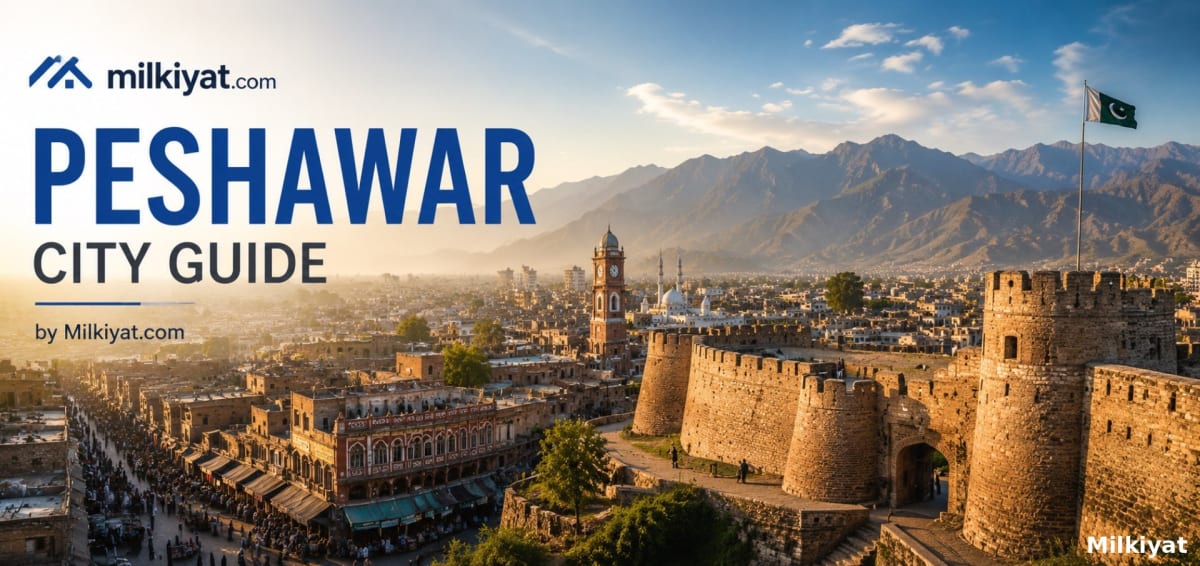
Peshawar: South Asia's oldest city, KP's capital. 2,500 years of history, Gandhara heritage, Silk Road bazaars & a growing property market. Full area guide.
Peshawar Area Guide — History, Culture, Real Estate & Travel | Milkiyat
Peshawar is the oldest living city in South Asia, the capital of Khyber Pakhtunkhwa, and the gateway between two worlds. With a recorded history dating to at least 539 BCE, it has been the capital of the Gandhara civilisation, a Silk Road caravanserai, the winter capital of the Durrani Empire, a Sikh stronghold, a British frontier garrison — and today, a city of 1.9 million people that carries all of that history on its shoulders with remarkable ease. To walk through Peshawar is to walk through time.
Recorded history from at least 539 BCE — oldest living city in South Asia
Status
Provincial capital of Khyber Pakhtunkhwa (KP)
Population (city)
1,905,975 (2023 census); ~2.3 million estimated 2025
District population
4,758,762 (Peshawar District, 2023 census)
National ranking
8th most populated city in Pakistan
Elevation
331 m (1,086 ft) above sea level
Civilisations
Gandharan Buddhist capital, Silk Road hub, Mughal city, Durrani winter capital, Sikh stronghold, British frontier post
Heritage sites
1,840 historical sites identified in Peshawar alone out of 3,000 across KP
Strategic value
Gateway to Khyber Pass; closest major Pakistani city to Torkham border; terminus of proposed Trans-Afghan Railway
Economy
Provincial capital services, Afghan transit trade, education hub, healthcare referral centre, manufacturing
Property market
Active and growing; Hayatabad, DHA Peshawar, University Town are premier zones
Cuisine
Nationally and internationally acclaimed; Namak Mandi and Qissa Khwani are essential food stops
Overview
Most great cities announce themselves with skylines or sprawl. Peshawar announces itself differently — through smell, sound, and a particular quality of light that feels older than it has any right to.
The scent of wood smoke and dry fruits hits you somewhere near Chamkani. The sound of Pashto — fast, guttural, musical — takes over from the motorway's white noise. By the time you reach the old city and the minaret of Mahabat Khan Mosque rises above the rooftops of the bazaar, you understand that this is not merely a city. It is a civilisation that has never fully stopped running.
Peshawar is the capital of Khyber Pakhtunkhwa, the largest Pashtun-majority city in Pakistan, and by any serious archaeological reckoning, the oldest continuously inhabited city in South Asia — its recorded history running from at least 539 BCE. The Department of Archaeology has formally recognised it as the Oldest Living City in South Asia, a designation supported by 1,840 identified historical sites within the city limits alone.
But Peshawar is not merely a museum. It is a functioning, growing, commercially active city of nearly 2 million people, the economic hub of Pakistan's northwest, the fulcrum of Afghan transit trade, the referral destination for healthcare and education across the former FATA districts, and increasingly, a city whose property market is attracting serious investor attention.
Its contradictions are what make it extraordinary: ancient and urgent, conservative and cosmopolitan, proud of its past and entirely engaged with the present.
Quick Facts
Category
Details
Official Name
Peshawar (پېښور)
Urdu / Pashto
پشاور / پېښور
Province
Khyber Pakhtunkhwa (KP)
District
Peshawar District
Coordinates
34°00′52″N, 71°34′03″E
Elevation
331 m (1,086 ft)
City Area
215 km²
Metro Area
1,257 km²
Postal Code
25000
Area Code
091 (+92-91)
Time Zone
PKT — UTC+5
Mayor
Zubair Ali (JUI-F)
Languages
Pashto (dominant), Hindko, Urdu
National Ranking
8th most populated city in Pakistan
Nearest Border
Torkham (Afghanistan) — ~55 km via Khyber Pass
Distance to Islamabad
~170 km via M-1 Motorway; ~2 hours
Distance to Kabul
~250 km via Torkham-Jalalabad road
Airport
Bacha Khan International Airport (PEW) — domestic and international services
Geography & Location
Peshawar sits at the eastern end of the Peshawar Valley — a broad, relatively flat basin flanked by mountains that gradually close in as you move west toward the Khyber Pass. The Bara River runs through the southern reaches of the district. To the northwest, the Hindu Kush and Sulaiman ranges begin their ascent. To the east, the Margalla Hills and the Indus plain stretch toward Rawalpindi and Islamabad.
This geography has defined Peshawar's role for millennia. It is the last major city before the mountains close in and the Khyber Pass begins — and therefore the first major city that anyone arriving from Central Asia would reach. Every empire that wanted to control the passage between South Asia and Central Asia needed to hold Peshawar.
Regional Position
Direction
What Lies There
West (~55 km)
Torkham border crossing; Khyber Pass; Afghanistan's Nangarhar Province
North
Khyber District; Bajaur; Dir; eventually Chitral and Gilgit-Baltistan
East (~170 km)
Islamabad/Rawalpindi via M-1 Motorway
South
Kohat; Bannu; Waziristan
Southeast
Attock; Punjab boundary
The Peshawar Valley's elevation of roughly 331 metres makes it significantly hotter than comparable KP cities to the north. This is the plains zone of the province — not the highlands. Summers are intense; winters mild by Pakistan's standards.
Climate & Best Time to Visit
Peshawar has a hot semi-arid climate (Köppen: BSh) with significant seasonal variation. Summers are genuinely hot — June regularly touches 40–41°C — while winters are mild and occasionally foggy. Monsoon contributes to July and August rainfall, but Peshawar sits at the far western edge of the monsoon's reach, so rainfall is less predictable and more episodic than in Lahore or Karachi.
Monthly Climate Data (Long-Term Averages)
Month
Avg High (°C)
Avg Low (°C)
Avg Rain (mm)
Character
January
18
5
25
Mild days; cold nights; occasional fog; dry
February
20
7
43
Warming; some rainfall; pleasant
March
24
11
74
Spring; wettest pre-summer month; ideal
April
31
17
48
Warm; pleasant evenings; gardens in bloom
May
37
22
32
Hot; dry; early summer
June
41
27
8
Peak heat; very dry; avoid outdoor midday activity
July
38
27
164
Monsoon; intense rainfall episodes; humid
August
36
26
52
Still hot; monsoon tail; humid
September
33
22
14
Cooling; pleasant evenings
October
28
14
18
Ideal — clear, warm days, cool nights
November
22
9
18
Cool; dry; very comfortable
December
18
5
19
Mild; occasional fog; quiet season
Annual average temperature: 22.3°C. Annual precipitation: ~817–844 mm.
Best Time to Visit
October–March is the optimal window. October and November offer the best balance of clear skies, warm days, and cool evenings without any of summer's extremes. March is pleasant but can be wet. June through September is challenging for outdoor exploration due to intense heat; June in particular — with temperatures regularly exceeding 40°C — is the most demanding month for visitors.
History — 2,500 Years in Brief
To understand Peshawar's property market, its trade networks, its cultural confidence, and its hospitality culture, you need to understand its history. No other city in Pakistan has been shaped by so many civilisations over so long a period.
The Deep Past: Purushapura and Gandhara
Peshawar's recorded history begins around 539 BCE, though archaeological evidence suggests earlier settlement. In the ancient world, it was called Purushapura — meaning "City of Men" in Sanskrit — and served as the centre of the Gandhara civilisation, one of the most remarkable cross-cultural syntheses in human history: Greek artistic influence, Buddhist philosophy, and Central Asian trade combined in sculpture, architecture, and scholarship that still impresses the world's greatest museums.
Under the Kushan Empire (1st–3rd century CE), Peshawar became an imperial capital under Kanishka the Great. The Kanishka Stupa — built to house sacred relics of the Buddha — was among the tallest structures in the ancient world. Chinese pilgrims Fa-Hian (5th century CE) and Xuanzang (7th century CE) both recorded detailed accounts of the city's Buddhist monuments, giving historians an extraordinary window into ancient Peshawar.
The Peshawar Museum today holds one of the world's most important collections of Gandharan Buddhist art — over 14,000 items, many recovered from the surrounding region's archaeological sites.
The Silk Road Era
By the 2nd century BCE, Peshawar — situated by the Bara River and controlling the Khyber Pass approach — had become a key Silk Road caravanserai. Traders from Xian, Samarkand, and Bukhara moved through it en route to Lahore, Amritsar, and Delhi. The Gor Khatri complex (now an archaeological excavation site of international significance) began its long history as a resting place for caravans and their goods. The Qissa Khwani Bazaar — the Bazaar of Storytellers — evolved as the social and commercial hub of this transit economy: a place where merchants waited, traded, exchanged news, and told stories.
Mughal Reconstruction and the "City of Flowers"
The Mughals transformed Peshawar's urban fabric. Emperor Shah Jahan patronised major construction works, including the Mahabat Khan Mosque (completed 1630) and extensive garden layouts that earned the city its lasting nickname: Shaher-e-Gul — City of Flowers. The old city's labyrinthine street plan, with its specialised bazaars, caravanserais, and residential mohallas (quarters), dates substantially from this period.
The Durrani Empire and Sikh Conquest
In 1747, Peshawar fell within the Durrani Empire founded by Ahmad Shah Durrani (Ahmad Shah Baba). From 1776, it served as the Durrani winter capital — a status that reflected the valley's strategic and agricultural richness. The city was captured by the Sikh Empire under Ranjit Singh in 1823, remaining under Sikh control until the British annexation of Punjab in 1849.
The Sikh period left architectural marks of its own — modifications to Bala Hisar Fort and fortifications across the old city — and represents the last pre-colonial phase of Peshawar's ancient political life.
British Colonial Peshawar
The British arrived as part of the post-Sikh War settlement and turned Peshawar into the critical northwestern administrative garrison of the North-West Frontier Province (NWFP). Colonial-era buildings — Islamia College (1913), Edwardes College, the Cunningham Clock Tower, the Lady Reading Hospital, and the cantonment infrastructure — fundamentally shaped the city's modern form.
The British also transformed the bazaar economy. Until the mid-1950s, Peshawar had a city wall with sixteen gates — a medieval urban boundary that survived the colonial period before eventually being dismantled.
In the 1960s and 1970s, Peshawar found an unlikely place on the global tourist map as a major stop on the Hippie Trail — the overland route from Europe to South Asia — attracting young Western travellers drawn by its bazaars, its Afghan connections, and its legendary hospitality.
The Soviet-Afghan War and Afghan Refugees
The Soviet invasion of Afghanistan in 1979 changed Peshawar permanently. The city became a major staging point for the mujahideen resistance, hosting CIA operations, ISI networks, foreign volunteers, weapons shipments, and eventually a massive, sustained flow of Afghan refugees. At its peak, the Afghan refugee population in and around Peshawar was among the largest urban refugee concentrations in the world.
This history fundamentally altered Peshawar's demographics, economy, and urban character. The Afghan commercial presence in neighbourhoods like Hayatabad — where Afghan traders, entrepreneurs, and professionals concentrated — became a permanent economic feature of the city.
Post-2001 and the Security Decade
After the 2001 US intervention in Afghanistan, Peshawar entered its most difficult modern period. As a frontier city adjacent to active conflict, it bore the weight of bombing campaigns, militant infiltration, and significant civilian casualties through the 2000s and into the early 2010s. The Army Public School (APS) attack on 16 December 2014 — in which 149 people, mostly schoolchildren, were murdered by Pakistani Taliban militants — was among the worst terrorist atrocities in South Asian history and catalysed a fundamental shift in Pakistan's counter-terrorism posture.
Since 2014, security conditions in Peshawar have improved dramatically. Military operations, improved intelligence coordination, and physical infrastructure upgrades have transformed the security environment. The city has rebuilt, expanded, and reasserted its identity as a centre of commerce and culture.
Key Historical Timeline
Era
Period
Key Fact
Gandharan Settlement
~1600 BCE–539 BCE
Known as "Udyana" (the garden) in ancient Hindu epics
Recorded history begins
539 BCE
Oldest recorded history in South Asia
Alexander's campaigns
327 BCE
Alexander the Great fought in this valley before crossing to the Punjab
Kushan Empire / Kanishka
1st–3rd century CE
Imperial capital; Kanishka Stupa among tallest buildings of ancient world
Buddhist pilgrims
5th–7th century CE
Fa-Hian and Xuanzang recorded detailed accounts of city's monuments
Silk Road peak
~2nd BCE–15th century CE
Qissa Khwani and Gor Khatri as caravanserai hubs
Mughal era
16th–17th century
"City of Flowers"; Mahabat Khan Mosque (1630); Shah Jahan's gardens
Durrani Empire
1747–1823
Peshawar as Durrani winter capital from 1776
Sikh Empire
1823–1849
Ranjit Singh's capture; Sikh fortification of Bala Hisar
British colonial
1849–1947
City wall with sixteen gates; Islamia College (1913); NWFP capital
Pakistan era
1947–present
Provincial capital of NWFP, then KP; Afghan wars reshape demographics
149 killed (mostly children); watershed in Pakistan's counter-terrorism
Post-2014 recovery
2015–present
Dramatic security improvement; TransPeshawar BRT; DHA development
The Name: City of Flowers
Peshawar's nickname — Shaher-e-Gul (City of Flowers) — originates from the Mughal period, when Emperor Shah Jahan commissioned gardens and parks across the valley, transforming what was already a significant city into a place of deliberate beauty. The gardens gave the valley its floral association; the name has stuck for four centuries even as the gardens themselves have long given way to urbanisation.
The word Peshawar itself has multiple proposed etymologies. The most accepted derivation connects it to the Sanskrit Purushapura (City of Men), later Persianised through Mughal and Durrani usage to its present form. An alternative reading from the Pashto translates approximately as "the frontier town" — a meaning that captures the city's essential geopolitical character across all periods of its history.
Culture & Identity
Peshawar is the cultural capital of Pakistan's Pashtun heartland — and Pashtun culture is one of the most distinctively developed in the subcontinent, with its own honour code, hospitality tradition, oral literary heritage, music, and food culture that differ markedly from every other regional culture in Pakistan.
Ethnic and Linguistic Composition
The majority population is Pashtun, speaking Central Pashto as the primary language. The Hindko-speaking community — associated historically with the city's merchant and artisan classes — has been present for centuries and contributes to the urban character of the old city neighbourhoods. Urdu operates as the language of formal and cross-ethnic communication, commerce, and media. The city's Afghan population adds Dari and Afghan Pashto dialects to this linguistic mix.
Language Group
Community
Role
Pashto (Central)
Pashtun majority
Dominant; street-level, domestic, political
Hindko
Historic city merchant class
Old city neighbourhoods; bazaar commerce
Urdu
Cross-community; formal contexts
Media, education, government, commerce
Dari/Afghan Pashto
Afghan resident community
Hayatabad; trade networks
Pashtunwali in Practice
Peshawar is the urban expression of Pashtunwali — the ancient Pashtun code of honour that governs social behaviour across the entire Pashtun belt. In the city, Pashtunwali is not a tribal formality but a lived cultural operating system. Its three pillars most visible to outsiders:
Melmastia (hospitality) — guests are received with food and respect before any business is transacted. This is not performance; it is expectation. A Peshawari tea house is not merely a commercial establishment; it is an extension of this social architecture.
Nanawatai (asylum/sanctuary) — a guest who requests protection must be given it, regardless of circumstances. This principle shaped Peshawar's response to Afghan refugees across decades; entire communities were absorbed because turning away those who seek shelter violates the deepest code.
Badal (justice/revenge) — the principle of proportional response to wrong. In urban Peshawar this manifests less in physical conflict and more in the fierce commercial loyalty and equally fierce commercial competition for which Peshawari traders are regionally famous.
Arts, Music and Literature
Pashto literature and music both trace significant roots to Peshawar. Rahman Baba (1650–1711) — the great Sufi Pashtun poet buried in a shrine outside the city — is to Pashto literature what Bulleh Shah is to Punjabi: the beloved voice of the people, memorised and recited across generations. His poetry combines spiritual devotion with earthy wisdom and remains genuinely popular, not merely academically appreciated.
Rabab music (the plucked string instrument central to Afghan and Pashtun musical tradition), ghazals in Pashto, and the rhythmic patterns of attan (the traditional Pashtun circle dance performed at celebrations) are living cultural forms in the city, not museum pieces.
The Hujra — the communal male reception room where decisions are made, stories told, and community bonds reinforced — functions in Peshawar's neighbourhoods as a social institution that pre-dates and outlasts every formal political structure the city has seen.
The Afghan Connection
Peshawar has hosted Afghan communities continuously since the 1980s. Several generations of Afghan traders, professionals, students, and refugees have settled in the city — particularly in Hayatabad and the surrounding townships. The cultural exchange has been bidirectional: Peshawaris and Afghans share Pashto language, Pashtunwali values, and culinary traditions, while the Afghan community has contributed to Peshawar's commercial dynamism and its role as an informal gateway to Central Asia.
The ancestral homes of Dilip Kumar and Raj Kapoor — two of Bollywood's most legendary stars, both born in Peshawar before Partition — have been purchased by the KP government and are being converted into museums. Their Peshawari heritage is a point of civic pride that crosses Pakistan-India cultural borders.
The Pashtun Code — Pashtunwali in an Urban Setting
The version of Pashtunwali that operates in Peshawar is not identical to the tribal form practised in the mountains. Urban life, commerce, education, and two generations of engagement with the wider world have refined its expression. But the core values remain visible:
A deal struck with a handshake and verbal commitment is binding. Written contracts matter less than honour.
Generosity is competitive — hosts seek to outdo each other in the quality of hospitality they offer guests.
Family reputation is a primary asset, carefully managed across generations.
Education, particularly for sons, is a matter of family honour. Peshawar's high investment in private schools reflects this value.
Community disputes are often resolved through informal mediation — via respected elders, intermediaries, or the hujra — before reaching any formal mechanism.
For investors and business partners: understanding that trust precedes transaction in Peshawar's commercial culture is not optional knowledge. It is the entry fee.
Cuisine — Why Peshawar Is Pakistan's Food Capital
Peshawari cuisine has an argument to make that Lahori food lovers may resist but cannot entirely dismiss: Peshawar produces some of the most architecturally pure, ingredient-focused food in the subcontinent. The emphasis is on quality of meat and fire, with minimal spice interference. This is cooking that has no need to hide.
Essential Peshawari Dishes and Food Culture
Item
Description
Where to Find
Chapli Kebab
Flat minced-beef patty with tomato, green chilli, dried pomegranate seed, and coriander; cooked in animal fat on iron griddle
Everywhere; Taru Jabba on GT Road and Jalil Kabab House are institutions
Dumba Karahi
Lamb tail-fat karahi; rich, gelatinous, extraordinary; the specialist's order
Khyber Charsi Tikka, Namak Mandi
Mutton Karahi
Wok-cooked lamb with tomato; Peshawar's version is more austere and truer than any other city's
Namak Mandi food street
Kabuli Pulao
Afghan-influenced rice dish with lamb, raisins, carrots; fragrant, subtle
Old city restaurants; Afghan-run eateries in Hayatabad
Peshawari Naan
Thick, dough-leavened flatbread baked in clay oven; distinctive sweetness from milk and egg
Any traditional bakery in the old city
Qehwa
Cardamom-spiced green tea; often with pistachios or almonds; served in copper samovars
Every tea house; Qissa Khwani in particular
Dry Fruits and Nuts
Afghanistan-sourced walnuts, apricots, pine nuts, raisins, pistachios; sold by weight in the old bazaar
Qissa Khwani and surrounding dry fruit markets
Brain Masala
Spiced lamb brain; acquired taste; iconic in the old city
Andarsher market; specialist restaurants
Sajji
Whole lamb or chicken marinated simply and slow-roasted over fire; minimalist and magnificent
Multiple specialist restaurants
Namak Mandi — The Culinary Heart
Namak Mandi (Salt Market) in the old city is Peshawar's definitive food street — and one of the finest in Pakistan. Originally a wholesale salt and spice market, it has evolved into the city's premier karahi destination. The restaurants here are not tourist productions; they are functional, often chaotic, wood-fire kitchens producing food at volumes that require industrial-scale butchery. Going at lunch hour on a Friday is an experience that should be on every food traveller's itinerary.
Qissa Khwani — The Bazaar of Storytellers
Qissa Khwani Bazaar (Storytellers' Bazaar) is both a food destination and a cultural institution. The qahwa khanas (tea houses) along its lanes have been serving green tea to travellers, merchants, and storytellers since at least the Silk Road era. Some traditional tea houses still operate today, though the bazaar itself has largely transitioned to dry fruit, fabric, and handicraft retail. The atmosphere — narrow lanes, wooden balconies overhead, the smell of spices and smoke — is irreplaceable.
Economy & Strategic Position
Peshawar functions as the economic engine of Khyber Pakhtunkhwa and the commercial gateway between Pakistan and both Afghanistan and Central Asia. Its economy is diversified across government/public sector, trade, education, healthcare, and manufacturing.
Economic Pillars
Sector
Scale
Key Notes
Government & Public Sector
Large
Provincial capital; major employer across administration, military, judiciary
Afghan Transit Trade
Major
Torkham is the primary Pakistan-Afghanistan land crossing; Peshawar is the last major Pakistani commercial hub before the border
Education
Significant
Major universities draw students from KP, merged districts, FATA, Gilgit-Baltistan, and Afghanistan
Healthcare
Regional hub
Lady Reading Hospital, KMC Teaching Hospital; referral destination for entire KP and former FATA
Saddar, Qissa Khwani, Namak Mandi; dry fruits and Afghan goods trade
Hospitality & Tourism
Growing
Bacha Khan Airport with international connections; hotels serving transit, business, and heritage tourism
Afghan Trade Dependency
Peshawar's economy has a structural dependency on Pakistan-Afghanistan trade relations that is both its greatest opportunity and its most significant vulnerability. When relations are positive and the Torkham crossing operates smoothly, Peshawar's wholesale, transport, and hospitality sectors all benefit. When relations sour — as they have periodically since 2021 under the Taliban government — the effects are felt immediately in Hayatabad's hospitals, hotels, restaurants, and schools, which depend significantly on Afghan patients, visitors, and students.
Pakistan's major exports to Afghanistan include cement, steel products, textiles, footwear, sugar, flour, and poultry — much of this trade flows through Peshawar's logistics networks. The city's transport and labour sector has a substantial stake in maintaining open trade corridors.
The Trans-Afghan Trade Corridor
The most transformative long-term economic development on Peshawar's horizon is the Trans-Afghan Railway — a proposed 774-kilometre rail link connecting Termez (Uzbekistan) → Mazar-i-Sharif → Kabul → Peshawar. Estimated cost: approximately USD 4.8 billion.
If completed, this project would make Peshawar the southern terminus of the first direct railway link between Central Asia and South Asia, connecting the landlocked economies of Uzbekistan, Kazakhstan, and Turkmenistan to the Arabian Sea ports of Karachi and Gwadar via Peshawar. The project is active — Uzbekistan, Afghanistan, and Pakistan signed formal agreements in 2023 and 2024 — though timeline to completion remains uncertain.
The Khyber Pass Economic Corridor (KPEC) — a 47.5-km four-lane expressway connecting Peshawar to Torkham — is a complementary infrastructure project expected to create over 100,000 jobs and drive industrial expansion in KP's merged districts.
For property investors: both projects, if realised, would fundamentally reprice commercial and logistics real estate in and around Peshawar.
Key Neighbourhoods & Districts
Peshawar's urban geography divides naturally into several distinct zones, each with its own character, price dynamics, and demographic profile.
Neighbourhood Overview
Area
Character
Best For
Hayatabad
Modern planned township; 7 phases; wide roads; industrial estate adjacent
Hayatabad is Peshawar's most desirable and modernly planned township, developed from the late 1970s onward in seven distinct numbered phases. Named after Hayat Mohammad Khan Sherpao (the first Governor of KP and founding member of PPP), it lies on Jamrud Road in Peshawar's western reaches, adjacent to the Hayatabad Industrial Estate and close to the Khyber Agency approach.
The township offers wide roads, parks, commercial centres, educational institutions, and healthcare facilities. It is the western terminus of the TransPeshawar Bus Rapid Transit (BRT) line. The community ranges from multi-generational local families to Afghan residents and international expats.
Old City — Where History Still Lives
The Old City (Andar Shehr — Inner City) is the original urban core of Peshawar, shaped by two millennia of continuous settlement. Its narrow lanes, mohallas (quarters) organised by trade and community, and historic buildings — including Sethi Mohalla, Mahabat Khan Mosque, Gor Khatri, and Qissa Khwani — represent an irreplaceable urban heritage. The KP government has invested in conservation of key sites, including Sethi Haveli (opened to visitors in 2021) and Gor Khatri.
For property: Old City real estate carries heritage value and strong rental yields from commercial use, but requires careful title diligence due to the complexity of generational ownership in densely subdivided plots.
Real Estate & Property Market
Peshawar's property market is one of KP's most active and most diversified — from heritage commercial plots in the old bazaar to master-planned DHA Phases on the city's western fringe. The 2022–2023 market correction, driven by Pakistan's broader economic pressures and FBR taxation changes, has largely been absorbed, and the 2024–2025 period shows clear recovery signals.
Market Segments
Segment
Current Status
Price Range (2024–25 estimates)
Trend
Hayatabad residential
Most active; strong demand
10 Marla: PKR 2.5–5 Cr; 1 Kanal: PKR 4–10 Cr
Upward
DHA Peshawar plots
Recovering; 1 Kanal files up from lows
1 Kanal base plots: PKR 1.9–2.0 Cr
Recovery; DHA Ballot 2026 anticipated
University Town
Stable; institutional demand
10 Marla: PKR 1.5–3 Cr
Stable
Saddar / Cantt commercial
Premium; limited supply
Office: PKR 2–5 Cr per Marla
Stable-upward
Old City commercial
Complex; specialised
Variable; bazaar-adjacent premium
Location-specific
Regi Model Town / Warsak Road
Affordable; appreciation potential
5 Marla: PKR 40–80 Lakh
Developing
Bahria Town Peshawar
New entry (2024 launch)
File prices currently forming
Early-stage
DHA Peshawar — The Investment Story
DHA Peshawar, launched in 2015, is the first Defence Housing Authority project in Khyber Pakhtunkhwa. Located near Nasir Bagh Road and Northern Bypass, it spans residential plots of 5, 8, 10 Marla, 1 Kanal, and 2 Kanal, and commercial plots across multiple blocks. Early investors (2017–2020) saw significant appreciation. The 2022–2023 correction brought 1 Kanal prices in developed blocks down to PKR 1.65–1.70 Crore, before the recovery toward PKR 1.90–2.00 Crore in 2024–2025.
The DHA Ballot 2026 — anticipated allocation of non-balloted files held by investors since 2015–2016 — represents a significant market event. File-to-plot conversion typically triggers substantial price appreciation as tangible ownership replaces paper allocation.
DHA has also announced INNOVISTA Khyber, an IT Park within DHA Peshawar, adding a technology and commercial dimension to what was primarily a residential development.
Key Investment Considerations
Factor
Assessment
Market liquidity
Good in Hayatabad and DHA; thinner in Old City and peripheral areas
Title clarity
Generally strong in planned societies (DHA, Hayatabad, University Town); complex in Old City
FBR taxation
CGT at 15% for filers; 15–45% for non-filers; important due diligence factor
Afghan trade exposure
Commercial properties near Torkham trade corridors benefit from/are exposed to bilateral relations
University Town and Saddar produce stable institutional rental income
Security premium
Post-2014 improvement has unlocked investor confidence not present in the prior decade
Heritage Sites & Attractions
Peshawar has 1,840 identified historical sites within the city limits — more archaeological density than almost any comparable city in South Asia. The problem is not a shortage of heritage; it is managing, preserving, and presenting what exists.
Major Heritage & Cultural Sites
Site
Type
Key Detail
Peshawar Museum (Gandhara Museum)
World-class museum
~14,000 items; one of world's most important Gandharan Buddhist art collections; mandatory visit
Built 1630 under Shah Jahan; white marble façade; intricate frescoes; active place of worship
Bala Hisar Fort
Historic fortress
Durani-Sikh-British era; "High Fort"; panoramic city views; currently occupied by Frontier Corps
Sethi House (Sethi Mohalla)
19th-century merchant havelis
7 havelis built 1884 by Sethi family; Central Asian/Bukhara-influenced wooden architecture; converted to museum
Gor Khatri
Archaeological complex
Layers from Buddhist, Mughal, and colonial periods; active excavation; international scholarly significance
Islamia College University
Colonial-era academic landmark
Built 1913; Mughal-Islamic architecture; declared national heritage; Quaid-e-Azam's personal interest
Cunningham Clock Tower
Victorian colonial landmark
City centre; British-era timekeeper; heritage streetscape
Bab-e-Khyber
Ceremonial gateway to Khyber Pass
Symbolic entrance to historic pass; Jamrud area
Jamrud Fort
Historic fort
Entrance to Khyber Pass; gateway to Central Asia trade route
Dilip Kumar's Ancestral Home
Heritage building
Purchased by KP government; being converted to museum
Raj Kapoor's Ancestral Home
Heritage building
Purchased by KP government; being converted to museum
Rahman Baba's Shrine
Sufi shrine
Dedicated to Peshawar's beloved 17th-century Pashto poet; site of spiritual and cultural pilgrimage
Namak Mandi
Historic food market
Salt and spice market turned premier karahi food street; culinary heritage site
Gor Khatri — Peshawar's Archaeological Ground Zero
Gor Khatri deserves special mention. This ancient complex in the heart of the old city has served, successively, as a Buddhist monastery, a Mughal caravanserai, a Sikh temple, and a British administrative compound. Active excavations are ongoing and continue to produce finds of significant archaeological importance. It represents, more than any other single site, the palimpsest quality of Peshawar's history — layers of civilisation literally stacked on top of each other.
Museums
Museum
Collection Focus
Peshawar Museum (Provincial Museum)
Gandharan Buddhist art; Kushan-era sculpture; Indo-Greek coins; Partisan and Indo-Scythian pieces
Islamia College Museum
University heritage; Pashtun cultural artefacts
Sethi House Museum
19th-century merchant life; Central Asian trade connections; wooden architecture heritage
Education & Healthcare
Education
Peshawar is the educational capital of KP and the former FATA, drawing students from across the province, from the merged districts, from Gilgit-Baltistan, and from Afghanistan. The concentration of universities and colleges creates both a demographic driver for residential rental demand and a long-term human capital asset for the city.
Institution
Type
Significance
University of Peshawar
Public university; founded 1950
Flagship; humanities and sciences; 25,000+ students
Islamia College University
Public university
Historic campus; national heritage status
Khyber Medical University (KMU)
Medical university
Major healthcare education hub for KP
Agricultural University Peshawar
Public university
Agricultural sciences; research
Edwardes College
Historic college (colonial-era)
Established 1900; arts and sciences
FATA University (sub-campus)
Merged-district university
Growing presence
Army Burn Hall College
Elite secondary
Highly competitive; prestigious
Private school expansion has been significant in the past decade. Hayatabad, University Town, and DHA host the highest concentration of premium private schools, reflecting the value the urban professional and returning diaspora population places on education quality.
Healthcare
Peshawar is the medical referral capital for the entire northwest of Pakistan, drawing patients from KP, the merged districts, FATA, Gilgit-Baltistan, and even from across the Afghan border.
Facility
Capacity/Significance
Lady Reading Hospital (LRH)
Largest hospital in KP; ~1,600 beds; founded 1924; named after Lady Reading
Khyber Teaching Hospital
Major public teaching hospital; KMU affiliated
Hayatabad Medical Complex
Western Peshawar's major referral hospital
Northwest General Hospital
Private sector; growing significance
Private Clinics and Specialist Practices
Significant growth in Hayatabad and University Town
The healthcare sector's role as a regional hub creates persistent commercial real estate demand — medical office space, pharmacy retail, and proximity-based residential rental — in the corridors near major hospitals.
Infrastructure & Connectivity
Road and Motorway
Route
Distance
Notes
M-1 Motorway → Islamabad
~170 km
~2 hours; highest-quality intercity route in Pakistan's northwest
N-5 (GT Road) → Rawalpindi
~185 km
Historical Grand Trunk Road; slower but passes through historic towns
Torkham border (Afghanistan)
~55 km via Khyber Pass route
Significant security protocols at crossing
Kohat → southern KP
~55 km
Connects to Hangu, Bannu, and Kurram via tunnelled route
Air — Bacha Khan International Airport
Bacha Khan International Airport (PEW) serves both domestic and international routes, including direct services to:
Domestic: Karachi, Lahore, Islamabad, Quetta
International: Dubai, Abu Dhabi, Saudi Arabia (Jeddah/Riyadh/Medina), Muscat, and other Gulf destinations serving the large KP diaspora
The airport has undergone capacity expansion in recent years and handles a significant volume of overseas Pakistani returnees and diaspora visitors.
TransPeshawar — Bus Rapid Transit
The TransPeshawar BRT (locally called Speedo Bus) is Pakistan's first fully operational Bus Rapid Transit system — a USD 310 million ADB-financed project inaugurated in 2020–2021. It runs a 27-km dedicated corridor from Hayatabad in the west through the city centre to Chamkani in the east, with segregated lanes, modern stations, and climate-controlled buses.
The BRT has had a measurable effect on property values along its corridor and has reframed urban mobility in a city previously characterised by fragmented minibus and rickshaw networks.
Digital Connectivity
All major Pakistani mobile operators (Jazz, Telenor, Zong, Ufone) provide 4G and expanding 5G coverage in Peshawar. Fibre internet is available in developed residential areas including Hayatabad, University Town, and DHA.
Security Context
Peshawar's security story is one of the most significant urban transformations in Pakistan's recent history — from the country's most targeted provincial capital to a functioning, commercially active city that foreign investors and domestic tourists are increasingly visiting.
The Dark Decade (2007–2014)
The period from 2007 to 2014 was Peshawar's most severe. Suicide bombings, targeted assassinations, market attacks, and the broader spillover from Pakistan's northwest counter-insurgency operations made the city genuinely dangerous for both residents and outsiders. The Army Public School attack (December 16, 2014) — in which 149 people were killed, the majority children — was the nadir.
The Recovery (2015–Present)
The National Action Plan (NAP) announced in the aftermath of the APS attack, combined with the military's Operation Zarb-e-Azb and subsequent operations, fundamentally altered the security dynamic. Key changes:
Military check-posts and intelligence networks significantly disrupted militant infrastructure
Physical barriers and surveillance in commercial areas improved
Civilian security forces strengthened and better equipped
Counter-terrorism courts established and functional
The current security environment in Peshawar — while still requiring vigilance and impossible to describe as risk-free — is dramatically improved from the 2008–2014 period. Business investment has returned. The hotel sector has expanded. International organisations maintain active presence. Domestic tourism to the city and through it to KP's natural attractions has resumed.
Ongoing risks include the potential for isolated extremist incidents and the broader instability associated with the Pakistan-Afghanistan border. Visitors should consult current travel advisories before visiting.
Challenges & Opportunities
Challenges
Challenge
Severity
Direction
Air quality / pollution
High
Peshawar ranks among Pakistan's most polluted cities; winters particularly bad
Traffic congestion
High
Urban growth has outpaced road infrastructure; BRT partially addresses this
Water supply stress
Medium-High
District population growth straining supply
Afghan refugee integration
Medium
Long-term fiscal and social complexity; primarily humanitarian challenge
DHA INNOVISTA; young educated population; lower cost vs Lahore/Islamabad
Developing; 5-year horizon
Premium residential
Post-security recovery; diaspora demand; DHA Ballot catalyst
Active now
Hospitality / hotels
Growing domestic and international transit tourism
Growing; supply gap exists
Investment Outlook Summary
Investment Criteria
Assessment
Rating
Market scale
Large city; diversified economy; provincial capital
★★★★★
Heritage and cultural asset quality
Extraordinary; among the richest in South Asia
★★★★★
Infrastructure investment momentum
BRT operational; KPEC underway; airport expanding
★★★★☆
Real estate market liquidity
Good; multiple active segments
★★★★☆
Security improvement trajectory
Dramatic since 2014; most significant positive change
★★★★☆
Trans-Afghan corridor optionality
Potential game-changer for commercial/logistics property
★★★★☆
Air quality challenge
Real and worsening; regulatory attention required
★★☆☆☆
Political/governance stability
Provincial capital; KP governance improving
★★★☆☆
Overall investable case
Compelling; major city dynamics; catalysts in pipeline
★★★★☆
Milkiyat.com perspective: Peshawar is KP's primary property market — with the depth, diversity, and infrastructure to absorb significant investment across residential, commercial, and hospitality segments. The post-2014 security transformation has unlocked value that was previously inaccessible. The Trans-Afghan Railway, if delivered, rewrites the commercial geography of the entire city's northwestern districts.
Frequently Asked Questions
What is the best time to visit Peshawar?
October to March. October and November are ideal — clear skies, warm days, cool evenings. March is pleasant but can be wet. Avoid June through August for sightseeing; June's 40°C+ temperatures make extended outdoor exploration exhausting.
How do I get to Peshawar from Islamabad?
The M-1 Motorway connects Islamabad to Peshawar in approximately 2 hours (170 km). Bus services (Daewoo, Faisal Movers, and others) operate from Islamabad to Peshawar frequently. Bacha Khan International Airport handles domestic flights from Islamabad, Lahore, and Karachi.
Is Peshawar safe to visit?
Yes, with normal urban precautions. The security environment has improved dramatically since 2014. The city has functioning hotels, restaurants, tourist sites, and active domestic tourism. International travel advisories should always be consulted and updated before travel; conditions can change.
What is Peshawar famous for?
Chapli kebab, Qissa Khwani Bazaar, Gandharan Buddhist art at Peshawar Museum, the Mahabat Khan Mosque, Bala Hisar Fort, the Khyber Pass, and its role as South Asia's oldest continuously inhabited city.
What language do people speak in Peshawar?
Pashto is the dominant language. Hindko is spoken by the old-city merchant community. Urdu is universally understood and used in formal, commercial, and educational contexts.
What is the Gandhara civilisation and why does Peshawar matter to it?
Gandhara was one of antiquity's great civilisations — a fusion of Greek artistic influence (from Alexander's campaigns), Buddhist philosophy, and Central Asian trade that produced extraordinary sculpture, architecture, and scholarship. Peshawar (ancient Purushapura) was its most important city. The Peshawar Museum holds the world's finest public collection of Gandharan art.
What are the best areas to buy property in Peshawar?
Hayatabad (premium established residential), DHA Peshawar (investment; long-horizon appreciation; DHA Ballot 2026 event coming), University Town (stable; institutional rental), Saddar/Cantt (commercial premium). Each serves different investor profiles and timelines.
What is the TransPeshawar BRT?
Pakistan's first fully operational Bus Rapid Transit system, running 27 km from Hayatabad to Chamkani. ADB-financed; operational since 2020–2021. Has improved urban mobility and influenced property values along its corridor.
Conclusion
There is a city in Pakistan where a bazaar that was already ancient when the Mughal Emperor Shah Jahan built his garden there still operates today — where green tea is poured from copper samovars, dry fruits arrive from across the Afghan border, and the same narrow lanes that hosted Silk Road caravans now carry motorcycles and smartphone screens.
That city is Peshawar.
It is complicated — as every city that has survived 2,500 years of conquest and commerce tends to be. It has scars from its difficult recent decades that have not fully healed. Its air quality is a genuine problem. Its traffic is a genuine problem. Its relationship with the instability next door is permanent.
But it is also alive in a way that few cities achieve — alive with commerce, with culinary pride, with hospitality that operates as a social code rather than a commercial calculation, with the deep cultural confidence of a people who know exactly who they are and where they come from. The Peshawar Museum alone — with its Gandharan Buddhist sculptures staring serenely across four centuries of history — is worth a flight from anywhere in South Asia.
For the investor, Peshawar is the largest, most liquid, and most economically diversified property market in Khyber Pakhtunkhwa, with infrastructure catalysts now in play that make the medium-term case as strong as it has ever been. For the traveller, it is the beginning of the Silk Road — the point where South Asia becomes Central Asia, and the hospitality is, as it always has been, extraordinary.
This guide was researched and produced by Milkiyat.com — Pakistan's digital real estate platform. Last updated: June 2026. For the latest property listings in Peshawar and Peshawar District, visit milkiyat.com/areas/peshawar.